

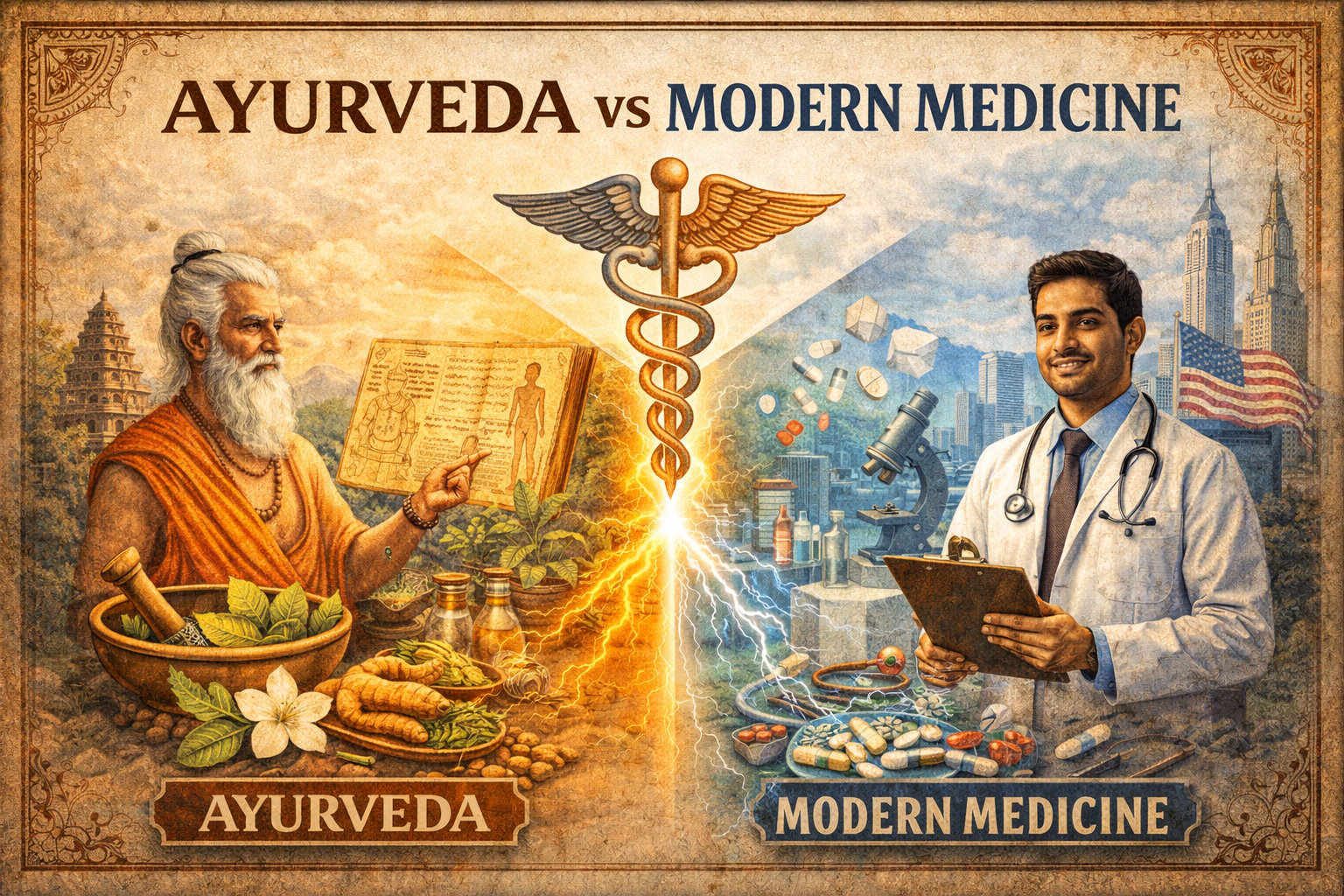
Differences, Strengths, and How They Can Work Together
Introduction
In today’s world, people have more healthcare options than ever before. Two systems that often come into conversation are Ayurveda—the ancient holistic science from India—and modern medicine (often called allopathic or conventional medicine). At first glance, they seem to operate in completely different universes. One relies on pharmaceuticals and surgery; the other uses herbs, diet, and lifestyle. One treats symptoms; the other seeks root causes. Yet both aim to alleviate suffering and restore health. Understanding the differences, strengths, and limitations of each system empowers us to make informed choices. Increasingly, people are discovering that Ayurveda and modern medicine are not necessarily opponents—they can be powerful allies in a truly integrative approach to health.
Key Differences at a Glance
Before diving deep, it is helpful to outline the fundamental differences between the two systems.
| Aspect | Ayurveda | Modern Medicine |
| Origin | Ancient India, over 5,000 years old | Evolved from Western scientific traditions, especially since 19th century |
| Core Philosophy | Balance of doshas, mind-body-spirit integration, prevention | Biochemical and anatomical focus, disease as pathology |
| Approach | Individualized (based on constitution and current imbalance) | Standardized (based on clinical guidelines and averages) |
| View of Health | Dynamic balance among doshas, tissues, wastes, and mind | Absence of disease markers or pathological findings |
| Treatment Tools | Diet, lifestyle, herbs, detox (Panchakarma), yoga, meditation | Pharmaceuticals, surgery, radiation, physical therapy |
| Role of Patient | Active participant responsible for daily practices | Often passive recipient of treatment |
| Time Frame | Gradual, aimed at lasting root-cause resolution | Often fast-acting, especially for acute conditions |
| Evidence Base | Traditional knowledge, observational, growing modern research | Clinical trials, laboratory studies, evidence-based protocols |
These differences shape how each system approaches everything from a common cold to chronic disease.
Philosophical Foundations: Two Worldviews
At its heart, Ayurveda is built on the concept of balance. Health is seen as a dynamic state of equilibrium among the doshas (Vata, Pitta, Kapha), digestive fire (Agni), tissues (dhatus), and wastes (malas). Disease occurs when this balance is disturbed—often due to poor diet, lifestyle, stress, or seasonal changes. The goal of treatment is to restore balance using natural means that work with the body’s intelligence.
Modern medicine, by contrast, is rooted in reductionism and the biomedical model. It seeks to understand health and disease at the level of cells, molecules, genes, and pathogens. Disease is often defined as a deviation from normal physiological parameters—bacterial infection, tumor growth, hormonal deficiency. Treatment aims to correct the specific abnormality, often with targeted interventions like antibiotics, surgery, or hormone replacement.
Neither worldview is inherently superior; they simply ask different questions. Ayurveda asks, “Why has this person’s balance been disturbed?” Modern medicine asks, “What is the pathological mechanism, and what intervention can correct it?” Both are valuable, and each has domains where it excels.
Approach to Diagnosis
Diagnosis in Ayurveda is highly personalized. A practitioner uses observation (darshana), palpation (sparshana), and questioning (prashna) to understand the individual’s constitution (prakriti), current imbalances (vikriti), digestive strength, and toxin load. Pulse diagnosis (nadi pariksha) and tongue examination are key tools. The focus is on the person’s unique presentation, often before a named disease has fully formed.
Modern medicine relies on diagnostic tests—blood work, imaging, biopsies—to identify specific pathologies. It excels at pinpointing structural or biochemical abnormalities. This approach is powerful for conditions like fractures, infections, and tumors where objective markers are essential. However, it can struggle with conditions that lack clear biomarkers, such as chronic fatigue, fibromyalgia, or early-stage metabolic imbalances.
Treatment Approach: Symptom vs. Root Cause
One of the most commonly cited differences is that modern medicine tends to focus on symptom management, while Ayurveda targets root causes. This is an oversimplification but holds some truth.
In modern medicine, a patient with high blood pressure is often prescribed a beta-blocker or ACE inhibitor to lower the numbers. This can prevent complications like stroke or heart attack—a critical benefit. However, the underlying factors that led to hypertension (stress, poor diet, lack of exercise) may not be addressed unless the patient pursues lifestyle changes on their own.
In Ayurveda, the same patient would be evaluated for their doshic imbalance (typically aggravated Vata or Pitta), digestive health, and toxin accumulation. Treatment might include dietary modifications (reducing salt and processed foods, increasing cooling foods), herbs like arjuna or ashwagandha, stress reduction through meditation, and lifestyle adjustments. The goal is to remove the root causes so the body can naturally regulate blood pressure.
Both approaches have merit. Symptom control is vital in acute situations or when immediate risk is high. Root-cause resolution can lead to sustained wellness and reduced dependency on medications.
Pros and Cons of Ayurveda
Strengths of Ayurveda:
- Holistic: Treats the whole person—body, mind, senses, and spirit.
- Personalized: Recommendations tailored to individual constitution.
- Preventive Focus: Strong emphasis on daily and seasonal routines to maintain health.
- Low Side Effects: When practiced correctly under guidance, natural therapies have few adverse effects.
- Chronic Disease Management: Particularly effective for digestive disorders, anxiety, autoimmune conditions, and metabolic syndrome.
- Empowers Patients: Gives individuals tools to take charge of their own health.
Limitations of Ayurveda:
- Slower Results: Not suitable for emergencies or acute, life-threatening conditions.
- Variable Regulation: In countries like the USA, practitioners are not uniformly licensed, and quality control of herbs can vary.
- Limited Acute Care: Cannot replace emergency surgery, trauma care, or advanced intensive care.
- Requires Commitment: Success depends on patient’s willingness to follow diet and lifestyle changes.
- Research Gap: Although growing, the body of large-scale clinical trials is smaller than for modern medicine.
Pros and Cons of Modern Medicine
Strengths of Modern Medicine:
- Acute Care Excellence: Unmatched in trauma, surgical emergencies, heart attacks, strokes, and infections.
- Diagnostic Precision: Advanced imaging, laboratory tests, and genetic analysis allow accurate identification of many conditions.
- Rapid Symptom Relief: Pharmaceuticals can quickly reduce pain, fever, inflammation, and other distressing symptoms.
- Evidence-Based: Treatment protocols are grounded in rigorous clinical trials and peer-reviewed research.
- Life-Saving Interventions: Vaccines, antibiotics, organ transplants, and intensive care have dramatically extended lifespan.
Limitations of Modern Medicine:
- Symptom-Focused: Often treats symptoms rather than underlying causes, leading to chronic disease management rather than resolution.
- Side Effects: Pharmaceuticals frequently have adverse effects, some of which are severe.
- Fragmented Care: Specialization can lead to treating organs in isolation rather than the whole person.
- High Cost: Advanced interventions can be prohibitively expensive.
- Less Emphasis on Prevention: Preventive care is often limited to screenings rather than lifestyle transformation.
When to Use Ayurveda
Ayurveda is particularly well-suited for:
- Chronic Conditions: Digestive disorders (IBS, constipation, acid reflux), autoimmune diseases, chronic fatigue, fibromyalgia.
- Mental-Emotional Imbalances: Anxiety, mild to moderate depression, stress-related disorders, insomnia.
- Lifestyle-Related Issues: Weight management, metabolic syndrome, poor energy, skin conditions like eczema or acne.
- Prevention and Wellness: Individuals seeking to optimize health, boost immunity, and prevent future disease.
- Post-Treatment Recovery: Supporting the body after surgery or chemotherapy to rebuild strength and vitality.
- Pediatric and Geriatric Care: Gentle, natural approaches suitable for children and the elderly.
Ayurveda also excels in providing a framework for healthy living—diet, daily routines, seasonal practices—that anyone can adopt regardless of health status.
When to Use Modern Medicine
Modern medicine is indispensable for:
- Emergencies: Trauma, fractures, severe burns, acute chest pain, stroke, difficulty breathing.
- Infectious Diseases: Bacterial infections requiring antibiotics, severe pneumonia, sepsis.
- Life-Threatening Conditions: Heart attack, advanced cancer, organ failure, severe allergic reactions.
- Surgical Interventions: Appendicitis, hernias, tumors, obstetrical emergencies.
- Diagnostic Clarity: When a definitive diagnosis is needed through lab tests or imaging.
- Acute Exacerbations: Sudden worsening of chronic conditions that require immediate stabilization.
In these scenarios, delaying modern medical care to pursue only natural alternatives can be dangerous. Responsible Ayurvedic practitioners recognize these boundaries and refer appropriately.
Can They Work Together? The Case for Integrative Medicine
The most thoughtful approach to health today is not Ayurveda or modern medicine, but Ayurveda and modern medicine. Integrative medicine combines the strengths of both systems to provide comprehensive care. This is not about mixing randomly but about using each system where it is most effective.
Examples of integration:
- Cancer Care: Modern medicine provides surgery, chemotherapy, and radiation. Ayurveda can support the patient by reducing treatment side effects (nausea, fatigue), strengthening immunity, and improving quality of life during and after treatment.
- Autoimmune Disease: Modern medicine offers powerful immunosuppressants to control flare-ups. Ayurveda addresses root causes such as digestion, stress, and toxin accumulation, potentially reducing the frequency and severity of flares and allowing lower medication doses.
- Mental Health: Psychiatry provides medications for conditions like severe depression or bipolar disorder. Ayurveda adds lifestyle practices, diet, herbs, and stress management that support emotional stability and reduce side effects.
- Cardiovascular Health: Modern medicine manages acute events and provides medications for blood pressure and cholesterol. Ayurveda contributes dietary guidance, stress reduction, and herbal support to address underlying causes and potentially reduce medication needs over time.
Successful integration requires communication between practitioners and an informed patient who discloses all treatments to both sides. Many forward-thinking physicians and Ayurvedic practitioners now collaborate, recognizing that the whole is greater than the sum of its parts.
A Balanced Perspective
Neither Ayurveda nor modern medicine has all the answers. Modern medicine, for all its technological prowess, often falls short in addressing chronic disease, lifestyle-related conditions, and the deeper causes of imbalance. Ayurveda, while profound in its holistic wisdom, cannot replace the life-saving interventions of emergency care or advanced surgery.
The key is to move beyond the “either/or” mindset and embrace an “and” approach. By understanding the strengths and limitations of each system, we can make wise choices for our unique circumstances. Ayurveda offers a roadmap for daily living, prevention, and root-cause healing. Modern medicine provides unparalleled tools for acute care, diagnostics, and critical interventions. Together, they can form a truly comprehensive approach to health—one that honors both ancient wisdom and modern science.
As healthcare continues to evolve, the integration of traditional systems like Ayurveda with modern medicine is likely to grow. Patients are already voting with their feet—seeking the best of both worlds. By understanding how these two systems differ and complement each other, we can navigate our health journeys with confidence and clarity.