

Introduction
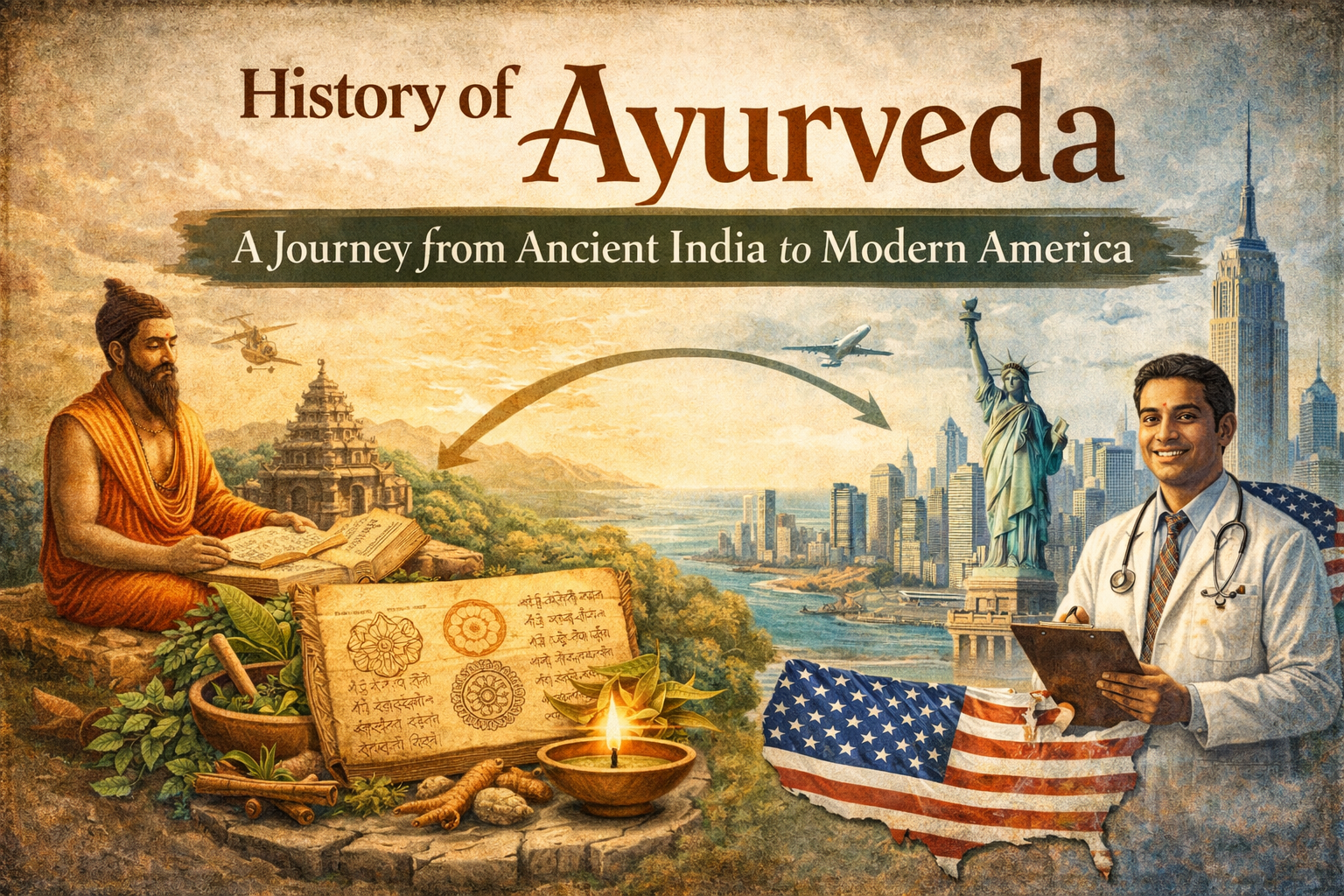
Ayurveda is often described as the world’s oldest continuously practiced system of medicine. Its history stretches back over 5,000 years, rooted in the spiritual soil of ancient India. Yet this is not merely a story of the past—it is a living tradition that has evolved, spread across continents, and found a vibrant new home in the United States. Understanding the history of Ayurveda helps us appreciate its depth and why it continues to resonate with millions today.
Ancient Roots: The Dawn of Ayurveda
The origins of Ayurveda lie in the oral traditions of ancient India, long before written language. The word “Ayurveda” itself—Ayur (life) + Veda (knowledge)—suggests its sacred origins. According to tradition, the knowledge of Ayurveda was revealed to ancient sages (rishis) through deep meditation. These rishis observed nature, the elements, and the human body, developing a system of healing based on balance, prevention, and harmony with the environment.
Archaeological evidence from the Indus Valley Civilization (circa 3300–1300 BCE) shows advanced urban planning, public baths, and an emphasis on hygiene, indicating a sophisticated understanding of health. While the exact timeline is debated, most scholars agree that Ayurveda as a formal system emerged at least 5,000 years ago. It was not merely a collection of remedies but a complete philosophy of living—covering diet, daily routines, seasonal practices, surgery, and spiritual well-being.
The Vedas and Classical Texts: Ayurveda Takes Form
The earliest written references to Ayurveda appear in the Atharva Veda, one of the four sacred Vedas. The Atharva Veda contains hymns and incantations for healing diseases, addressing mental afflictions, and promoting longevity. Over time, this knowledge was expanded and systematized into dedicated medical texts.
The three classical treatises form the bedrock of Ayurveda:
- Charaka Samhita: Compiled by the sage Charaka, this text focuses on internal medicine (kayachikitsa). It explains the concepts of tridosha (three bio-energies), agni (digestive fire), and the importance of diet and lifestyle. Charaka’s work is considered the definitive guide on preventive medicine and managing chronic conditions.
- Sushruta Samhita: Written by the sage Sushruta, this text is famous for its detailed descriptions of surgical procedures, including rhinoplasty (nose reconstruction), cataract surgery, and wound management. Sushruta is often called the “father of surgery” for his pioneering techniques and anatomical knowledge.
- Ashtanga Hridaya: Authored by Vagbhata, this text is a concise synthesis of the previous two works. It presents Ayurveda in a practical, easy-to-follow format and is widely used by practitioners today.
These texts were written in Sanskrit and have been preserved for over 2,000 years. They established a systematic framework that included diagnosis, treatment protocols, medicinal formulations, ethical guidelines for physicians, and even surgical instruments.
Evolution Through the Ages: Continuity and Adaptation
For centuries, Ayurveda flourished as the primary healthcare system of the Indian subcontinent. Universities like Taxila and Nalanda offered advanced training in Ayurveda alongside other disciplines. Royal courts employed skilled physicians, and monasteries served as healing centers.
During the medieval period (circa 700–1500 CE), Ayurveda continued to evolve. Commentaries were written on the classical texts, and new compendiums like the Madhava Nidana (a work on diagnosis) appeared. The system adapted to regional traditions while maintaining its core principles.
The colonial era (18th–20th centuries) brought challenges. British rule in India promoted Western medicine and marginalized indigenous systems. Ayurveda was often dismissed as unscientific, and many institutions were neglected. Yet the knowledge survived—passed down through families, community healers, and dedicated practitioners who preserved the tradition against odds.
Revival in India and the Birth of a Modern System
After India gained independence in 1947, a concerted effort was made to revive Ayurveda. The government established the Central Council of Indian Medicine (CCIM) to regulate education and practice. Ayurvedic colleges were opened across the country, and research institutes were founded to study classical formulations through a modern scientific lens.
Today, India has a robust Ayurvedic infrastructure: hundreds of colleges, tens of thousands of practitioners, and a vast industry of herbal products. Ayurveda is officially recognized as a national system of medicine alongside allopathy. Hospitals in India offer Panchakarma (detoxification) centers, and many people use Ayurveda as their primary healthcare or as a complement to conventional treatment.
Spread to Global Markets: Ayurveda Goes West
Ayurveda’s journey beyond India began slowly. In the 19th and early 20th centuries, Western scholars translated Sanskrit texts, sparking academic interest. However, it was the 1970s and 1980s that marked the real turning point. The rise of the counterculture movement, increased interest in meditation and yoga, and pioneers like Maharishi Mahesh Yogi brought Ayurveda to Western audiences.
Key milestones in global spread:
- 1970s–1980s: Maharishi Ayurveda introduced a simplified, mass-market version of Ayurveda, making concepts like doshas accessible to the West.
- 1980s–1990s: Books by Dr. Vasant Lad, Dr. Robert Svoboda, and other scholars made classical Ayurveda understandable to English-speaking audiences. They founded schools, clinics, and training programs in the United States and Europe.
- 2000s–present: The wellness industry embraced Ayurveda. Yoga studios began incorporating Ayurvedic workshops. Herbal supplements like ashwagandha, triphala, and turmeric gained mainstream popularity. Spas and retreat centers began offering Ayurvedic treatments, especially Abhyanga (oil massage) and Panchakarma.
Today, Ayurvedic products are sold in health food stores, online retailers, and even conventional pharmacies. Global market analysts project continued growth, driven by consumer interest in natural, preventive, and personalized health solutions.
Ayurveda in the USA Today
The United States has become one of the largest markets for Ayurveda outside India. While Ayurveda is not yet federally licensed as a medical system, it operates within complementary and alternative medicine (CAM) frameworks. Ayurvedic practitioners are not licensed as physicians in most states, but many work as health consultants, often in conjunction with yoga therapists, acupuncturists, and functional medicine doctors.
Several factors contribute to Ayurveda’s popularity in the USA:
- Demand for Personalization: Americans are drawn to the dosha system, which offers a personalized approach to diet and lifestyle.
- Chronic Disease Crisis: With rising rates of autoimmune conditions, digestive disorders, anxiety, and metabolic syndrome, many seek alternatives that address root causes.
- Integration with Yoga: The explosive growth of yoga in the USA has naturally led practitioners to explore Ayurveda as its sister science.
- Educational Opportunities: There are now dozens of Ayurvedic schools and professional organizations in the USA, such as the National Ayurvedic Medical Association (NAMA), which sets standards for education and practice.
- Research and Credibility: Universities and research institutions are increasingly studying Ayurvedic herbs and protocols. The National Center for Complementary and Integrative Health (NCCIH) funds studies on Ayurveda, lending it academic legitimacy.
- Accessibility: High-quality Ayurvedic herbs, books, online courses, and telehealth consultations make it possible for anyone to begin their Ayurveda journey from anywhere.
A Living Tradition
The history of Ayurveda is not a closed chapter—it is a story of continuity, resilience, and renewal. From the meditations of ancient sages to the shelves of American health stores, Ayurveda has adapted without losing its essence. Its core message—that health comes from balance and that each individual has a unique path to wellness—resonates as strongly today as it did 5,000 years ago. As more people seek sustainable, holistic ways to care for themselves, Ayurveda’s ancient wisdom will likely become an even more integral part of global health.