

Introduction
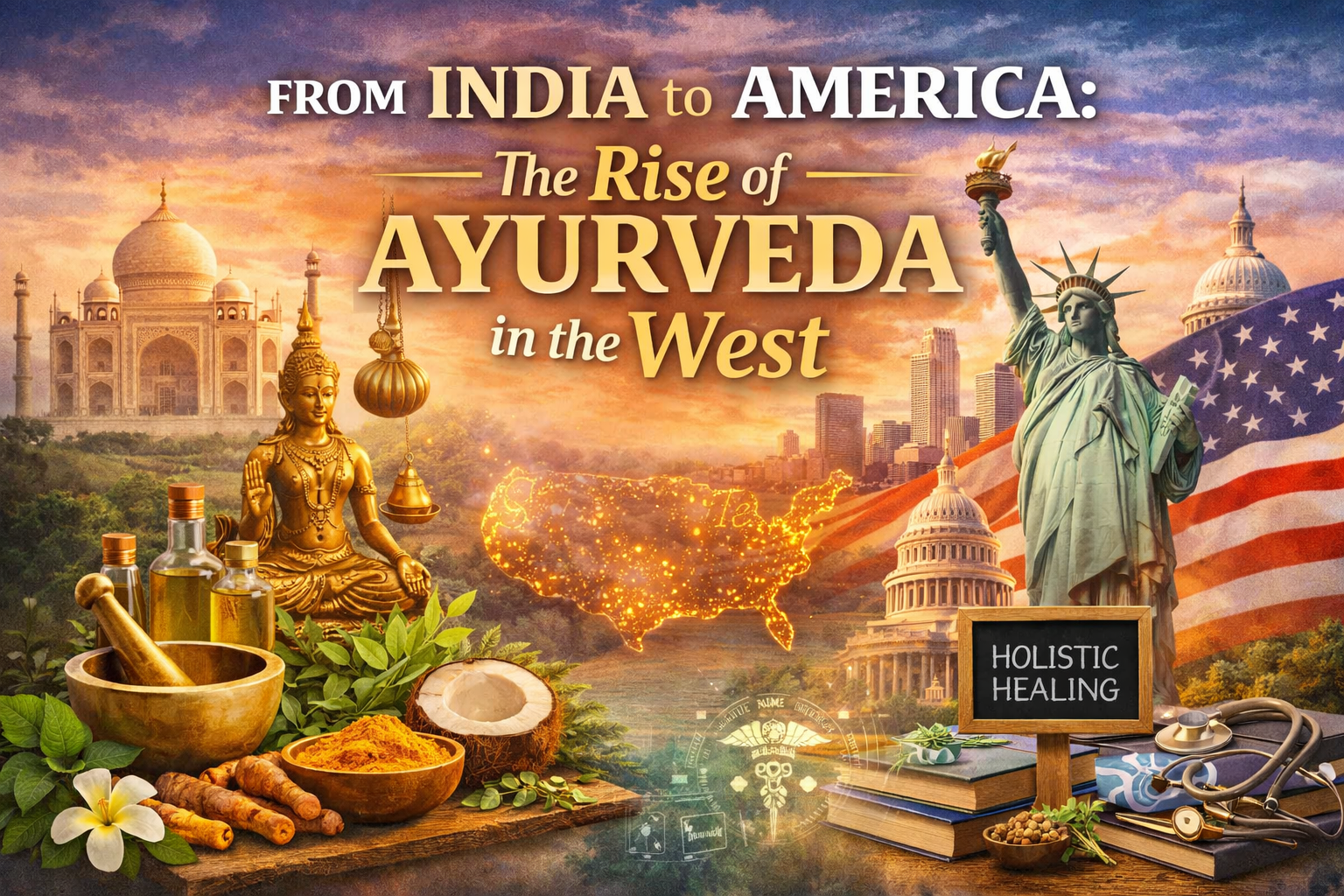
Ayurveda’s journey from the ancient forests of India to the bustling cities of America is a story of resilience, adaptation, and growing recognition. What began as a closely guarded tradition passed down through generations of sages is now a thriving presence in the Western world, embraced by millions seeking holistic health. This journey did not happen overnight. It took decades of dedicated pioneers, shifting cultural currents, and a growing dissatisfaction with conventional medicine’s limitations. Today, Ayurveda stands as one of the fastest‑growing complementary health systems in the West. This article traces the path of Ayurveda from its homeland to its new home, highlighting the key moments, figures, and trends that have shaped its rise.
The Ancient Roots: Ayurveda in India
Before it could travel West, Ayurveda had already flourished for thousands of years in India. Rooted in the Vedas, particularly the Atharva Veda, Ayurveda evolved into a sophisticated medical system with detailed texts like the Charaka Samhita, Sushruta Samhita, and Ashtanga Hridaya. For centuries, it was the primary healthcare system across the Indian subcontinent, supported by royal courts, universities like Taxila and Nalanda, and a vast network of family lineages.
The colonial period (18th–20th centuries) saw Ayurveda marginalized under British rule, as Western medicine was promoted and indigenous systems were suppressed. Yet the tradition survived through families and dedicated practitioners, and after India’s independence in 1947, it experienced a revival. By the mid‑20th century, Ayurveda was once again recognized as a formal system of medicine in India, with government support, educational institutions, and a growing body of research.
The First Seeds in the West
The earliest Western exposure to Ayurveda came through scholarly translations. In the 19th century, European Indologists translated Sanskrit texts, introducing Ayurvedic concepts to academic circles. However, these remained largely intellectual curiosities with little practical impact.
The real introduction to a broader Western audience began in the 1970s and 1980s. Two major forces converged: the Transcendental Meditation (TM) movement, led by Maharishi Mahesh Yogi, and the arrival of pioneering Ayurvedic teachers from India.
The TM movement, which gained significant popularity in the West, incorporated a simplified, mass‑market version of Ayurveda called Maharishi Ayurveda. It introduced concepts like doshas and herbal supplements to a generation already interested in meditation and alternative spirituality. While criticized by some for oversimplifying the tradition, it undeniably brought Ayurveda into the public consciousness.
Simultaneously, individual teachers began to lay the groundwork for classical Ayurveda in the West. Dr. Vasant Lad, a physician trained in India, arrived in the United States in 1979 and founded the Ayurvedic Institute in New Mexico, becoming one of the first to teach classical Ayurveda in English. Dr. Robert Svoboda, the first Westerner to graduate from a recognized Ayurvedic college in India, began publishing books and lecturing extensively. Dr. David Frawley (Vamadeva Shastri), a scholar of both Ayurveda and Vedanta, wrote foundational texts that integrated Ayurveda with yoga and Indian philosophy. These pioneers created the intellectual and institutional framework that would allow Ayurveda to grow.
The Role of Yoga
The parallel rise of yoga in the West cannot be overstated. Beginning in the late 19th century with Swami Vivekananda’s lectures and gaining momentum through the 20th century with teachers like B.K.S. Iyengar and Pattabhi Jois, yoga became a mainstream practice. By the 1990s, yoga studios were common in American cities, and millions were experiencing the benefits of asana, pranayama, and meditation.
For many, yoga was the gateway to Ayurveda. Practitioners realized that the physical and mental benefits of yoga could be deepened by understanding the Ayurvedic principles of diet, lifestyle, and constitution. Yoga teacher training programs began incorporating Ayurvedic modules, and today the two are often taught together as sister sciences. This synergy created a ready‑made audience for Ayurveda, one already invested in holistic well‑being.
Institutional Growth and Professionalization
The 1990s and 2000s saw the establishment of formal Ayurvedic education and professional organizations in the United States. Schools such as the California College of Ayurveda, Kripalu School of Ayurveda, and Mount Madonna Institute began offering certification programs. The National Ayurvedic Medical Association (NAMA) was founded in the early 2000s to set educational standards, develop ethical guidelines, and advocate for the profession. Today, NAMA recognizes several accredited programs and offers a national credential—the Ayurvedic Practitioner (AP)—to graduates who meet rigorous requirements.
The establishment of these institutions marked Ayurveda’s transition from a collection of individual practitioners to an organized profession. It also created pathways for American students to study Ayurveda without traveling to India, further accelerating its spread.
Ayurveda Meets Integrative Medicine
As integrative medicine gained traction in the early 2000s, Ayurveda found new allies. Major medical centers like the University of California, San Diego (UCSD) Center for Integrative Medicine began offering Ayurvedic consultations. The National Center for Complementary and Integrative Health (NCCIH) began funding research on Ayurvedic approaches, lending academic credibility. Conferences on integrative medicine increasingly included Ayurveda alongside acupuncture, functional medicine, and nutrition.
This period also saw the growth of Ayurvedic product availability. Companies like Banyan Botanicals, Organic India, and Himalaya brought high‑quality, sustainably sourced Ayurvedic herbs to the American market. Turmeric, ashwagandha, and triphala became staples in natural food stores, and consumer demand soared.
Cultural Shifts and the Wellness Boom
The 2010s ushered in the wellness boom, and Ayurveda was perfectly positioned to ride the wave. Several cultural shifts aligned with Ayurvedic principles:
- Demand for personalization: The dosha system offered a clear alternative to one‑size‑fits‑all health advice.
- Focus on prevention: With rising healthcare costs and chronic disease rates, Americans became more interested in preventing illness than merely treating it.
- Desire for natural solutions: Herbs, diet, and lifestyle appealed to those wary of pharmaceutical side effects.
- Mindfulness movement: Ayurveda’s emphasis on mental well‑being and daily rituals resonated with the growing interest in meditation and stress reduction.
Social media and celebrity endorsements amplified these trends. Influencers shared their Ayurvedic morning routines, dosha quizzes went viral, and figures like Deepak Chopra brought Ayurvedic concepts to mainstream audiences. By the end of the decade, Ayurveda had moved from niche to near‑mainstream.
Ayurveda Today in America
Today, Ayurveda is a vibrant and growing presence across the United States. There are hundreds of certified practitioners, dozens of schools, and a multi‑billion‑dollar market for Ayurvedic products. Ayurvedic concepts have influenced dietitians, yoga teachers, functional medicine doctors, and corporate wellness programs.
Yet challenges remain. Regulation is still fragmented—Ayurveda is not licensed at the federal level, and practitioners often operate as “health consultants” rather than medical professionals. Insurance coverage is limited, and quality control of imported herbs requires vigilance. There is also an ongoing conversation about cultural appropriation versus respectful adaptation, as Ayurveda’s Indian roots must be honored even as it evolves in Western contexts.
Despite these challenges, the trajectory is upward. The Ayurvedic community in the United States continues to professionalize, research is expanding, and public interest shows no signs of waning.
A Journey of Mutual Transformation
The rise of Ayurveda in the West has not been a one‑way transmission. As Ayurveda has taken root in America, it has been transformed by the encounter. American practitioners have emphasized practical applications, simplified complex concepts for beginners, and integrated Ayurveda with modern wellness modalities like functional medicine and coaching. At the same time, the core principles—balance, constitution, digestion, and lifestyle—remain intact, demonstrating the resilience of the tradition.
For India, Ayurveda’s global success has brought renewed pride and investment. For America, it has offered a rich, time‑tested framework for addressing chronic health challenges in a personalized, holistic way. The journey from India to America is still unfolding, and with each passing year, the connection deepens.
Conclusion
From the sacred texts of ancient India to the wellness centers of modern America, Ayurveda’s journey is a testament to its enduring wisdom. The path was paved by visionary teachers, a growing appetite for holistic health, and a recognition that true well‑being requires more than just managing symptoms. Today, Ayurveda stands at a crossroads—no longer an exotic import but a respected part of the American health landscape. As it continues to evolve, it carries with it the timeless promise that health is not merely the absence of disease but a vibrant state of balance, accessible to all who seek it.