

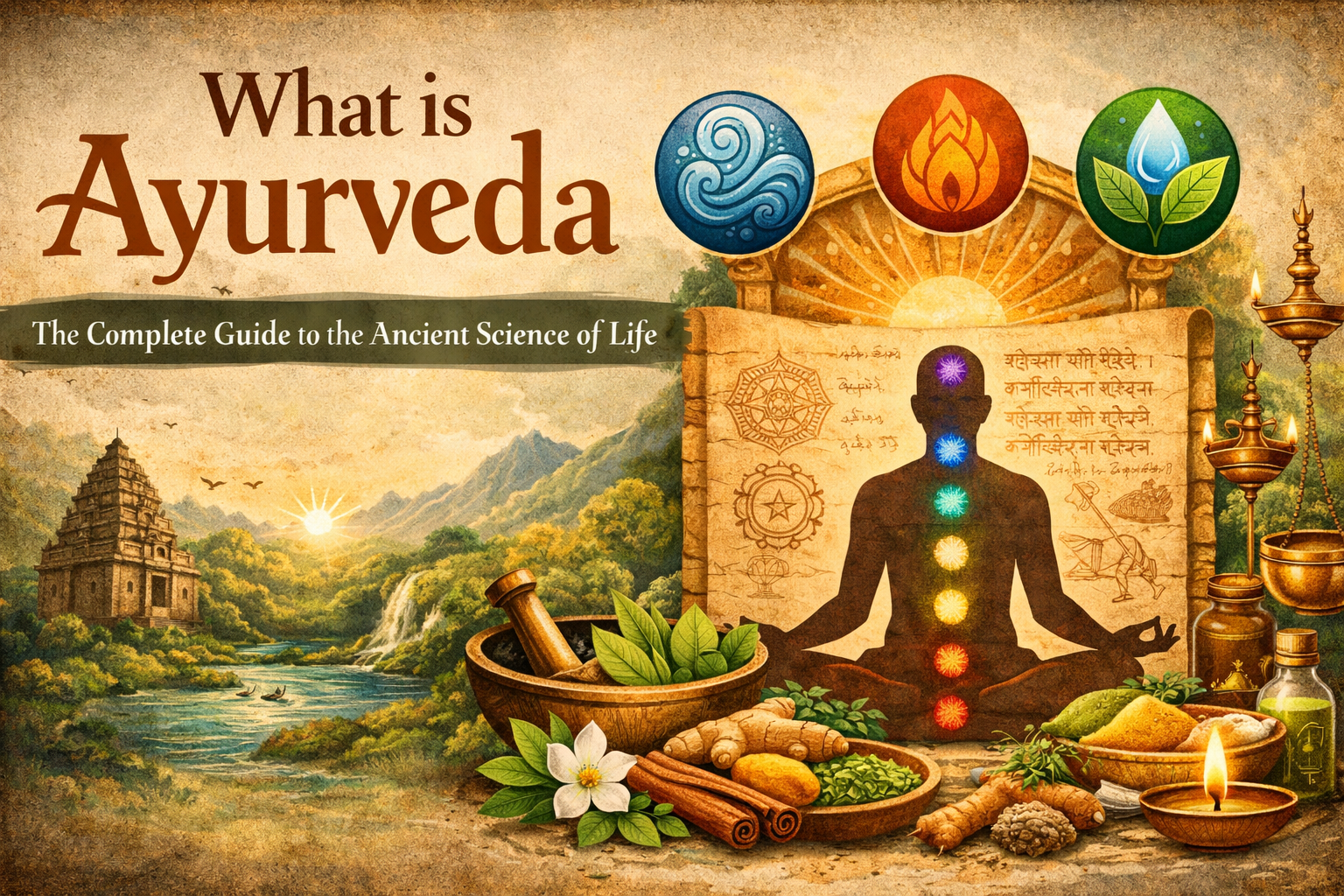
1. INTRODUCTION
Hook: Open with a relatable scenario—perhaps someone struggling with chronic stress, digestive issues, or fatigue despite modern medical interventions. Introduce Ayurveda as a solution that addresses root causes rather than just symptoms.
Brief Definition: State clearly that Ayurveda is a 5,000-year-old holistic healing system originating in India.
Thesis Statement: This article will explore Ayurveda’s definition, core philosophy, key principles, and why millions in the USA are turning to this ancient wisdom for modern health challenges.
2. WHAT DOES AYURVEDA MEAN? DECODING THE “SCIENCE OF LIFE”
Sanskrit Breakdown:
- Ayur = Life (encompassing body, mind, senses, and soul)
- Veda = Knowledge or Science
Expanded Meaning:
Explain that Ayurveda is not merely a system of medicine but a complete way of living. It teaches how to live—not just how to treat disease.
Key Quote (optional): Reference the classical definition from the Charaka Samhita:
“Swasthasya swasthya rakshanam, aturasya vikara prashamanam”
(The goal of Ayurveda is to preserve the health of the healthy and cure the disease of the diseased.)
Emphasize: This dual focus—prevention and cure—is what makes Ayurveda unique.
3. THE ORIGIN OF AYURVEDA: ANCIENT WISDOM, TIMELESS RELEVANCE
Historical Roots:
- Originated in India over 5,000 years ago
- Part of the Atharva Veda, one of the four sacred texts
- Passed down orally for centuries before being documented
The Foundational Texts:
- Charaka Samhita (focus on internal medicine)
- Sushruta Samhita (focus on surgery—Sushruta is considered the father of surgery)
- Ashtanga Hridaya (a concise compilation of both)
Cultural Context: Ayurveda is considered Upaveda (supplementary knowledge) to the Vedas, highlighting its spiritual and philosophical depth.
Visual Element Suggestion: A timeline graphic showing Ayurveda’s journey from ancient India to global recognition.
4. THE CORE PHILOSOPHY: BALANCE AS THE FOUNDATION OF HEALTH
The Central Principle: Health is not merely the absence of disease—it is a state of dynamic balance.
The Mind-Body Connection:
Ayurveda does not separate mental and physical health. Stress, emotions, and thoughts directly impact physical well-being, and vice versa.
Introduce the Five Elements (Panchamahabhuta):
Briefly explain that Ayurveda views everything in the universe—including the human body—as composed of five elements:
- Earth (Prithvi): Structure, solidity
- Water (Ap): Fluidity, cohesion
- Fire (Tejas): Transformation, metabolism
- Air (Vayu): Movement, dynamism
- Ether/Space (Akasha): Channels, potential
Transition to Doshas: These five elements combine to form three biological forces known as Doshas. (Promise a deeper dive in a future article—this creates internal linking opportunity.)
5. INTRODUCING THE THREE DOSHAS: YOUR UNIQUE BLUEPRINT
Purpose: This section serves as a teaser—enough to intrigue readers but not overwhelm them. It sets up future content.
Brief Overview:
| Dosha | Elements | Function | Characteristics (when balanced) |
| Vata | Air + Ether | Movement | Creative, energetic, flexible |
| Pitta | Fire + Water | Transformation | Intelligent, focused, ambitious |
| Kapha | Water + Earth | Structure & Stability | Calm, strong, nurturing |
Prakriti (Individual Constitution):
Explain that every person is born with a unique combination of these doshas (their Prakriti). This determines their physical build, digestive capacity, emotional tendencies, and susceptibility to imbalances.
Call-out Box: “Curious about your dosha? Take our free dosha quiz [link to future article] to discover your unique mind-body type.”
6. HOW AYURVEDA DIFFERS FROM MODERN MEDICINE
This is a critical section for establishing differentiation and authority. Use a comparison table or side-by-side format for clarity.
| Aspect | Ayurveda | Modern Medicine (Conventional) |
| Focus | Prevention + Root Cause | Symptom Management |
| Approach | Holistic (Mind, Body, Senses, Soul) | Reductionist (Targets specific organs/systems) |
| Treatment | Personalized (based on dosha) | Standardized (one-size-fits-all protocols) |
| Methodology | Diet, lifestyle, herbs, detoxification | Pharmaceuticals, surgery |
| View of Health | Dynamic balance | Absence of disease markers |
| Role of Patient | Active participant | Passive recipient |
Nuanced Take: Acknowledge that both systems have strengths. Ayurveda excels in chronic disease management, prevention, and lifestyle optimization. Modern medicine is invaluable for emergencies, trauma, and acute infections.
Key Point: Ayurveda doesn’t reject modern medicine—it complements it. Many practitioners advocate for an integrative approach.
7. WHY AYURVEDA IS SO POPULAR IN THE USA
This section adds relevance for your target audience and improves local SEO.
Key Drivers of Growth:
- Rise in Chronic Disease: Americans are seeking alternatives for conditions like autoimmune disorders, digestive issues, anxiety, and metabolic syndrome—areas where conventional medicine often offers limited solutions.
- Desire for Personalization: The dosha system appeals to people tired of generic health advice. It offers a framework tailored to the individual.
- Focus on Prevention: With healthcare costs skyrocketing, many are investing in proactive wellness rather than reactive treatment.
- Mind-Body Awareness: The popularity of yoga and meditation (both Ayurvedic sister sciences) has opened the door for Ayurveda. Many yoga practitioners naturally progress to exploring Ayurveda.
- Celebrity Endorsements & Media: High-profile figures like Deepak Chopra, Gwyneth Paltrow, and various wellness influencers have brought Ayurveda into mainstream conversation.
- Accessibility of Training: The number of Ayurvedic schools, practitioner programs, and online courses in the USA has grown exponentially over the past decade.
Statistic (if available): Mention the growing market size of Ayurvedic products in North America (projected to reach $X billion by 2030) to underscore legitimacy.
8. BENEFITS OF AYURVEDA: A HOLISTIC APPROACH TO WELLNESS
Present this as a concise, scannable list:
- Digestive Health: Ayurveda’s primary focus on Agni (digestive fire) offers solutions for bloating, IBS, constipation, and food sensitivities.
- Stress Management: Practices like Abhyanga (self-oil massage), meditation, and daily routines calm the nervous system.
- Sustainable Weight Management: Personalized diet and lifestyle recommendations, not restrictive fad diets.
- Improved Sleep: Simple routines and herbal supports for insomnia and irregular sleep patterns.
- Detoxification: Gentle, seasonal cleansing (Panchakarma) to eliminate accumulated toxins.
- Mental Clarity: Ayurveda addresses anxiety, brain fog, and emotional balance through diet, herbs, and daily practices.
- Immune Support: Building Ojas (vitality, immune strength) through nutrition and lifestyle.
Note: Emphasize that benefits are most profound when Ayurveda is adopted as a lifestyle, not a quick fix.
9. COMMON MISCONCEPTIONS ABOUT AYURVEDA
Address potential reader skepticism to build trust.
- Myth: Ayurveda is just herbs and oils.
- Fact: While herbs are used, Ayurveda is a comprehensive system with sophisticated diagnostics, dietary guidelines, and lifestyle protocols.
- Myth: Ayurveda is a religion.
- Fact: Ayurveda is a science. While it originated in a spiritual context, it is practiced by people of all faiths and requires no religious conversion.
- Myth: Ayurveda is unscientific.
- Fact: Modern research is validating many Ayurvedic principles. Institutions like the National Center for Complementary and Integrative Health (NCCIH) are funding studies on Ayurvedic approaches.
- Myth: You need an Ayurvedic practitioner to benefit.
- Fact: While complex conditions require expert guidance, many foundational principles (like eating mindfully, establishing a routine) can be adopted by anyone.
10. HOW TO START YOUR AYURVEDA JOURNEY
Provide actionable next steps. This keeps readers on your site and builds a pathway to conversion.
- Begin with Breakfast: Replace a heavy or processed breakfast with something warming and easy to digest (e.g., spiced oatmeal or kichari).
- Establish a Morning Routine: Wake up before 6 AM, scrape your tongue, drink warm water with lemon, and practice 5 minutes of deep breathing.
- Eat Your Largest Meal at Noon: Align with the body’s natural digestive peak when the sun is highest.
- Explore Your Dosha: Take a dosha quiz to understand your constitution.
- Consider an Ayurvedic Consultation: For personalized guidance, especially if dealing with chronic health issues.
11. CONCLUSION
Summarize: Ayurveda is not a passing trend—it is a time-tested system that offers practical, sustainable solutions for modern health challenges.
Reiterate Core Message: At its heart, Ayurveda is about returning to balance—within ourselves, with our environment, and with the rhythms of nature.